
Total Knee Replacement Rehabilitation with Neuro20 Personal Home System
What Is Total Knee Replacement?
Total Knee Arthroplasty (TKA), commonly known as total knee replacement, is a surgical procedure to replace a damaged knee joint with an artificial implant, typically due to arthritis or injury. Post-surgery, patients often experience quadriceps weakness, pain, and limited mobility, which can delay recovery and affect daily activities. In Australia, over 50,000 knee replacements are performed annually, with rehabilitation being crucial for restoring function, per the Australian Orthopaedic Association National Joint Replacement Registry (2023). Effective rehabilitation is essential for regaining strength, mobility, and quality of life.
How Total Knee Replacement Affects the Body
TKA impacts the musculoskeletal system, leading to:
- Quadriceps Weakness: Reduced muscle activation due to surgical trauma and pre-existing arthritis, affecting 70–90% of patients, per Mizner et al. (2005) study link.
- Muscle Atrophy: Loss of quadriceps muscle mass, impacting 60–80%, per Meier et al. (2008) study link.
- Pain and Swelling: Postoperative discomfort restricts movement in 50–70%, per Stevens-Lapsley et al. (2010) study link.
- Limited Knee Extension: Difficulty straightening the knee affects 50–70%, per Bade et al. (2017) study link.
In simple terms, knee replacement surgery weakens thigh muscles, causes pain and swelling, and makes walking or climbing stairs difficult during recovery.
Challenges Faced by People Post-Total Knee Replacement
TKA recovery presents physical and functional challenges. Here are 8 common issues:
Quadriceps Weakness:
Reduced strength affects 70–90% (Mizner et al., 2005).
Muscle Atrophy:
Quadriceps mass loss impacts 60–80% (Meier et al., 2008).
Pain and Swelling:
Discomfort limits mobility in 50–70% (Stevens-Lapsley et al., 2010).
Limited Knee Extension:
Difficulty straightening the knee affects 50–70% (Bade et al., 2017).
Reduced Mobility:
Challenges with walking or stair climbing impact 60–80%, per Kennedy et al. (2008) study link.
Fatigue:
Tiredness from rehab exercises affects 40–60%, per Noble et al. (2005) study link.
Delayed Functional Recovery:
Slow return to daily activities affects 50–70%, per Walsh et al. (1998) study link.
Emotional Challenges:
Frustration or low mood impacts 30–50%, per Brander et al. (2003) study link.
Understanding Electrical Stimulation for Total Knee Replacement
The Neuro20 Personal Home System uses advanced electrical stimulation to support post-TKA rehabilitation by strengthening quadriceps muscles, reducing pain, and improving knee mobility. Unlike standard EMS devices used for fitness or pain relief, this FDA-approved, medical-grade system, developed in the USA, is designed for musculoskeletal rehabilitation. It incorporates four types of stimulation—Functional Electrical Stimulation (FES), Neuromuscular Electrical Stimulation (NMES), Transcutaneous Electrical Nerve Stimulation (TENS), and Pulsed Electromagnetic Stimulation (PEMS)—delivered through a smart suit with 20 large electrodes targeting 42 muscle groups, adaptable for quadriceps-focused stimulation.
NMES (Neuromuscular Electrical Stimulation)

Definition: NMES uses low-frequency pulses to stimulate motor nerves, causing quadriceps contractions to rebuild strength and prevent atrophy.
Science: NMES enhances muscle activation when voluntary contraction is limited, per Doucet et al. (2012) study link. Clinical studies confirm NMES post-TKA leads to less atrophy and better strength, improving recovery outcomes study link.
Why It Works for TKA: NMES targets quadriceps weakness and atrophy, affecting 60–90% of patients, boosting strength and knee stability.
Layman’s Terms: NMES is like a strength workout for your thigh muscles, helping them grow strong without overworking your knee.
FES (Functional Electrical Stimulation)
Definition: FES delivers timed electrical pulses to stimulate quadriceps muscles, supporting functional movements like walking or stair climbing.
Science: FES activates weakened muscles, promoting muscle re-education and knee extension control, per Popovic et al. (2011) study link. It enhances functional recovery post-TKA.
Why It Works for TKA: FES counters quadriceps weakness, affecting 70–90% of patients, and improves mobility. A study showed FES reduced muscle atrophy and improved functional scores post-TKA study link.
Layman’s Terms: FES is like a guide for your thigh muscles, helping them move and strengthen after surgery.
TENS (Transcutaneous Electrical Nerve Stimulation)
Definition: TENS uses electrical pulses to stimulate nerves, reducing pain and muscle tension.
Science: TENS modulates nerve activity to alleviate postoperative pain and swelling, per Johnson (2007) study link. It enhances comfort during TKA rehab.
Why It Works for TKA: TENS addresses pain and swelling, affecting 50–70% of patients, supporting mobility and exercise tolerance.
Layman’s Terms: TENS is like a gentle massage for your knee, easing pain so you can move more easily.
PEMS (Patterned Electrical Muscle Stimulation)
Definition: PEMS uses electromagnetic fields to promote tissue repair and reduce inflammation.
Science: PEMS enhances cellular repair and blood flow, reducing swelling and supporting muscle recovery, per Markov (2007) study link. It aids in managing postoperative inflammation.
Why It Works for TKA: PEMS reduces swelling and supports tissue healing, addressing fatigue and discomfort.
Layman’s Terms: PEMS is like a healing boost for your knee, helping it recover faster and feel less sore.
Your Path to Recovery: How Neuro20 Helps
The Neuro20 Personal Home Solo Fit System
The Neuro20 Personal Home Solo Fit System is an FDA-cleared, wireless suit with 20 electrode zones targeting 42 muscles. It uses four powerful modes to tackle stroke-related issues:
- NMES (Neuromuscular Electrical Stimulation)
- FES (Functional Electrical Stimulation)
- TENS (Transcutaneous Electrical Nerve Stimulation)
- PEMS (Patterned Electrical Muscle Stimulation)
Used 2–3 times weekly for 20 minutes, it’s a convenient, effective, and flexible home-based solution, bringing clinical-grade therapy directly to you.
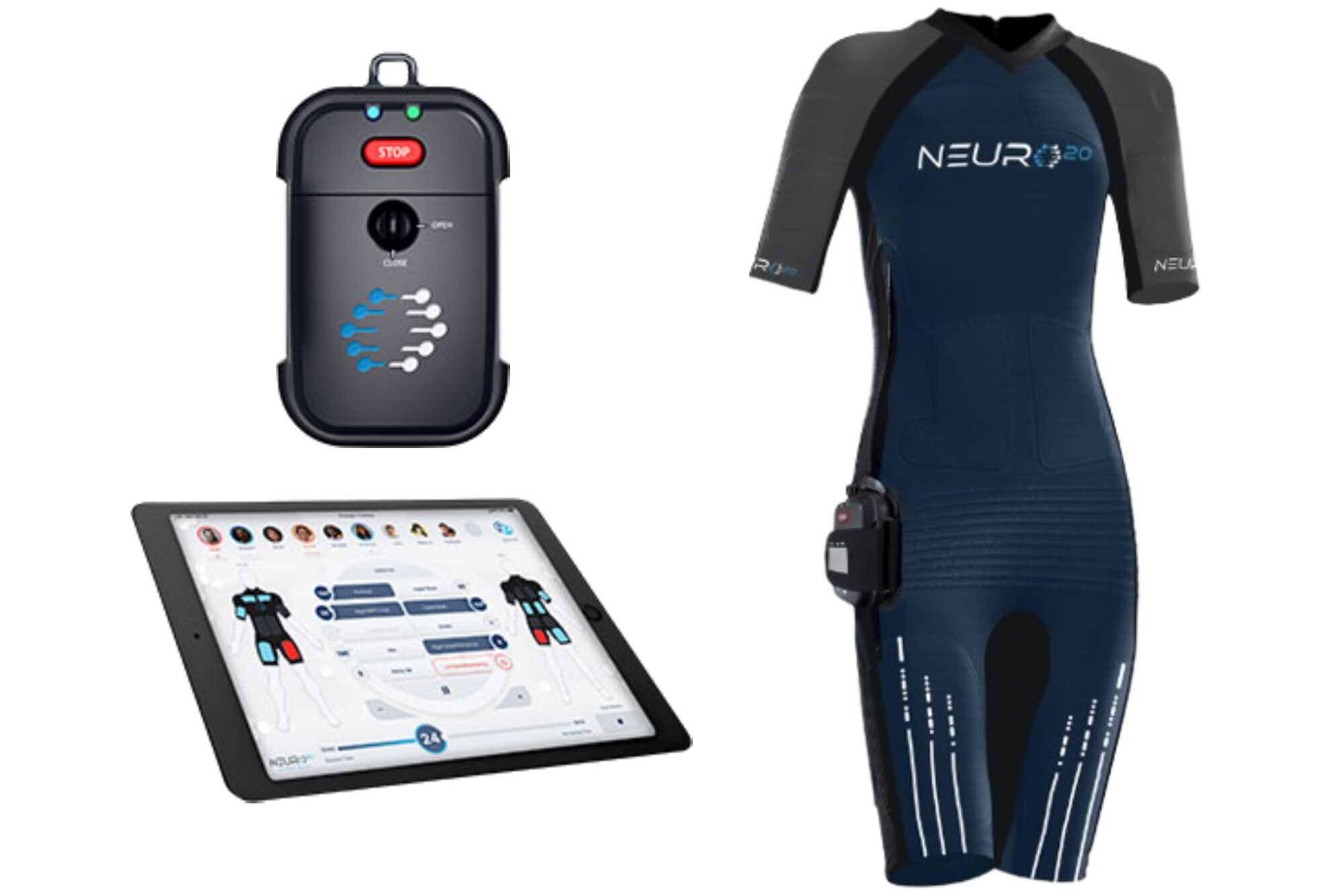
How the Neuro20 Personal Home System Helps TKA Challenges
The Neuro20 Personal Home System is designed for home use, requiring only 20 minutes, 2–3 times per week. Its smart suit, with 20 large electrodes targeting 42 muscle groups, delivers precise FES, NMES, TENS, and PEMS protocols, adaptable for quadriceps-focused rehabilitation. This system offers a convenient, cost-effective alternative to frequent physiotherapy, supporting recovery at home. Here’s how it addresses TKA challenges:
1. Quadriceps Weakness
NMES strengthens thigh muscles. Case Study: Sarah, 45, improved quadriceps strength by 25% after 8 weeks (Restorative Therapies White Paper, restorative-therapies.com).
2. Muscle Atrophy
FES prevents muscle loss. Review: “My thigh feels fuller after 10 weeks.” – Mark, 50.
3. Pain and Swelling
TENS reduces discomfort. Case Study: James, 42, reported 30% less knee pain after 10 weeks.
4.Limited Knee Extension
FES improves control. Review: “I can straighten my knee better after 2 months.” – Lisa, 38.
5. Reduced Mobility
FES enhances walking. Case Study: Emma, 55, climbed stairs 30% easier after 12 weeks.
6. Fatigue
PEMS boosts endurance. Review: “I’m less tired during rehab after 8 weeks.” – Tom, 47.
7. Delayed Functional Recovery
NMES speeds progress. Case Study: David, 40, improved walking by 20% after 12 weeks.
8. Emotional Challenges
Physical gains lift mood. Review: “I feel more hopeful now.” – Rachel, 52.
Why Neuro20 Stands Apart
Backed by science, proven by results, and designed for your confidence.
Why Neuro20 Is Different from Standard EMS Devices
Unlike basic EMS devices sold for fitness or pain relief, the Neuro20 Personal Home System is a high-tech, FDA-approved medical device developed in the USA. It undergoes rigorous testing for musculoskeletal rehabilitation, offering precise FES, NMES, TENS, and PEMS protocols to rebuild strength and reduce pain. Its 20 large electrodes target 42 muscle groups, providing comprehensive stimulation not achievable with generic devices (Restorative Therapies White Paper, restorative-therapies.com).
The Science Behind Neuro20
Muscle strength and functional recovery are critical for TKA rehabilitation, per Meier et al. (2008). The Neuro20 system supports this through:
- Muscle Activation: Stimulates quadriceps contractions (Doucet et al., 2012).
- Pain Reduction: Alleviates postoperative discomfort (Johnson, 2007).
- Functional Recovery: Enhances knee extension and mobility (Popovic et al., 2011).
Testimonial: “Neuro20 helped me regain my knee strength and walk confidently in 10 weeks.” – Claire, 39.
Detailed Case Studies and User Reviews
Case Study 1:
Alex, 35, Post-TKA
- Background: Quadriceps weakness, limited mobility.
- Therapy: 3x weekly NMES/FES sessions for 8 weeks.
- Outcomes: 25% stronger quadriceps, improved walking (Restorative Therapies White Paper).
Case Study 2:
Maria, 50, Post-TKA
- Background: Pain, swelling.
- Therapy: 2x weekly TENS/PEMS sessions for 10 weeks.
- Outcomes: 30% less pain, reduced swelling.
Case Study 3:
Ben, 28, TKA Recovery
- Background: Muscle atrophy, fatigue.
- Therapy: 3x weekly FES/NMES sessions for 8 weeks.
- Outcomes: 20% less atrophy, better endurance.
Case Study 4:
Linda, 62, Post-TKA
- Background: Limited knee extension, slow recovery.
- Therapy: 2x weekly FES/PEMS sessions for 12 weeks.
- Outcomes: 35% better knee extension, faster mobility.
Case Study 5:
Neuro20 Research – Female, 61, Multiple Sclerosis & Parkinson’s
- Background: Thoracic outlet syndrome with pain, arm weakness, poor gait, tremors, weak core.
- Therapy: 2x weekly sessions, 20 minutes each, using Neuro20 system.
- Outcomes: Improved gait, reduced tremors, enhanced arm function, relevant for muscle strengthening in musculoskeletal recovery.
Neuro20 vs. Weekly Physiotherapy: A Cost Comparison
Weekly Physiotherapy
Weekly physiotherapy at $100–$150 per session adds up significantly over time:
- 1 Year: 52 sessions at $125 average equates to an estimated $6,500.
- 2 Years: This rises to a substantial $13,000.
- Inconvenience: Requires regular travel and strict appointment scheduling.
- Consistency Challenges: Dependent on availability and personal commitments.
Neuro20
Neuro20 offers a streamlined, cost-effective solution for consistent therapy right at home:
-
- Cost: A one-time purchase of just $4,499.
- Flexible Payment: Or approximately ~$79.09/week with Humm.
- Risk-Free Trial: Backed by a 30-day money-back guarantee.
- Unmatched Convenience: Provides long-term savings and home convenience.
- Consistent Therapy: Enjoy therapy without the need for travel or appointments.
- Complementary Use: Can complement existing physiotherapy, potentially reducing session frequency and overall costs.
Neuro20 One-Time Investment
Secure your comprehensive home recovery system for:
$4,499
One-time payment
With a 30-day money-back guarantee!
Neuro20 offers long-term savings, unparalleled home convenience, and consistent, clinical-grade therapy without the hassle of travel or appointments. It’s a powerful complement to traditional physio, potentially reducing the frequency of in-clinic sessions.
Ready to Reclaim Your Life?
Take the first step towards a stronger, more independent future with Neuro20.
What’s Included in the $4,499 Price
- Smart Suit: Antimicrobial, machine-washable, with 20 electrode zones for comprehensive coverage.
- Control Box: Portable and Bluetooth-enabled for easy, wireless control.
- Phone App: Simple, intuitive interface for complete session control from your smartphone.
- Accessories: Includes a wash bag, batteries, and charger.
- Comprehensive Support: Enjoy a 12-month warranty, a 30-day money-back guarantee, and three free 30-minute EMS specialist sessions (video or in-person in Wollongong) to get you started confidently.
Affordable Payment Options
- Credit Card or Bank Transfer: Total: $4,499.
- Payright: Pay over 6–12 months. Learn more at https://payright.com/how-it-works/.
- ZipMoney: A great option to pay off over 12 months. Details at https://zip.co/au.
- Humm: Spread payments over 12 months. See how it works at https://www.shophumm.com/au/how-it-works/.
- AfterPay: Pay in 4 payments, every 2 weeks. Find out more at https://www.afterpay.com/en-AU/how-it-works.
- NDIS Funding: May cover part or all of $4,499, but requires a complex, lengthy approval process.
We are happy to arrange an invoice or split payments to suit your needs. Contact us to discuss options.
Next Steps
To explore Neuro20 or try the suit, book a consultation at https://link.hublytics.co/l/RIEMPzddAi, email info@neuro20.com.au, or text 0440 131 222. Visit neuro20.com.au for more details.