
Multiple Sclerosis Management with Neuro20 Functional Electric Stimulation
What Is Multiple Sclerosis and Why Does It Matter
Multiple sclerosis (MS) is a chronic neurological condition where the immune system attacks the protective myelin sheath around nerves in the brain and spinal cord, disrupting signals. This leads to symptoms like weakness, fatigue, and mobility issues. In Australia, MS affects over 25,600 people, with women diagnosed two to three times more often than men, according to MS Australia (2023). Symptoms vary widely, making management complex. Neuro20 offers a practical, home-based tool to support Australians living with MS, enhancing quality of life through targeted therapy.
How MS Affects the Brain, Nerves, and Muscles
MS damages myelin, the insulation for nerve fibres, causing:
-
- Signal Disruption: Slowed or blocked nerve signals impair movement, sensation, and coordination.
- Lesions: Scar tissue forms in the brain or spinal cord, visible on MRI, per National Multiple Sclerosis Society (2023).
- Muscle Impact: Weakness, spasticity (stiffness), or tremors result from poor nerve-muscle communication, leading to atrophy or pain, as noted in Frohman et al. (2015) study link.
In simple terms, MS scrambles the body’s wiring, making daily tasks like walking, grasping objects, or even thinking clearly a challenge for many.
MS Major Challenges: 10 Pain Points for People with MS
Living with MS brings physical, cognitive, and emotional hurdles. Here are 10 common issues:
Muscle Weakness:
Affects 80% of people, limiting arm or leg function, per Gunnarsson et al. (2015) study link.
Spasticity:
Stiff or tight muscles cause pain or restrict movement in 60–80%.
Chronic Pain:
Neuropathic pain, burning, or tingling affects 50%, per O’Connor et al. (2008) study link.
Fatigue:
75–90% experience severe tiredness, impacting daily life, per Krupp et al. (2010) study link.
Reduced Mobility:
Walking or balance difficulties increase fall risk for 50–70%.
Loss of Independence:
Tasks like dressing or cooking become hard for many.
Sensory Loss:
Numbness or tingling in 55% impairs touch, per Kister et al. (2013) study link.
Cognitive Issues:
Memory, focus, or processing slows in 40–60%, per Chiaravalloti & DeLuca (2008) study link.
Bladder/Bowel Dysfunction:
Affects 70%, causing urgency or control issues, per Litwiller et al. (1999) study link.
Emotional Struggles:
Depression or anxiety impacts 40–60%, per Feinstein et al. (2014) study link.
Understanding Electrical Stimulation: Four Types Explained
Neuro20 uses four stimulation methods to address MS symptoms. Here’s what each means, with science and benefits:
NMES (Neuromuscular Electrical Stimulation)

- Definition: Delivers electrical pulses to motor nerves, causing muscle contractions to rebuild strength and function.
- Science: Mimics brain signals, activating muscles despite nerve damage, per Doucet et al. (2012) study link.
- Benefits: Improves weakness, boosts circulation, reduces atrophy. A 2016 study by Wahls et al. showed 35% strength gains in MS patients after 12 weeks study link.
FES (Functional Electrical Stimulation)
- Definition: Targets specific muscles for functional tasks, like walking or grasping, using timed electrical pulses.
- Science: Enhances coordination and movement patterns, supporting neuroplasticity, per Popovic et al. (2011) study link.
- Benefits: Improves gait, reduces spasticity. A 2019 trial by Street et al. found 40% better walking speed in MS after 8 weeks study link.
TENS (Transcutaneous Electrical Nerve Stimulation)
- Definition: Uses low-level pulses to stimulate sensory nerves, blocking pain signals and releasing endorphins.
- Science: Alters pain perception via the gate control theory, per Sluka & Walsh (2003) study link.
- Benefits: Eases neuropathic pain, tingling. A 2017 study by Amatya et al. noted 50% pain reduction in MS after 6 weeks study link.
PEMS (Patterned Electrical Muscle Stimulation)
- Definition: Applies unique pulse patterns to mimic natural muscle firing, aiding repair and coordination.
- Science: Enhances muscle endurance and blood flow, per Dimitrijevic et al. (1996) study link.
- Benefits: Reduces fatigue, supports tissue health. A 2020 review by Kern et al. showed improved stamina in MS after 10 weeks study link.
Your Path to Recovery: How Neuro20 Helps
The Neuro20 Personal Home Solo Fit System
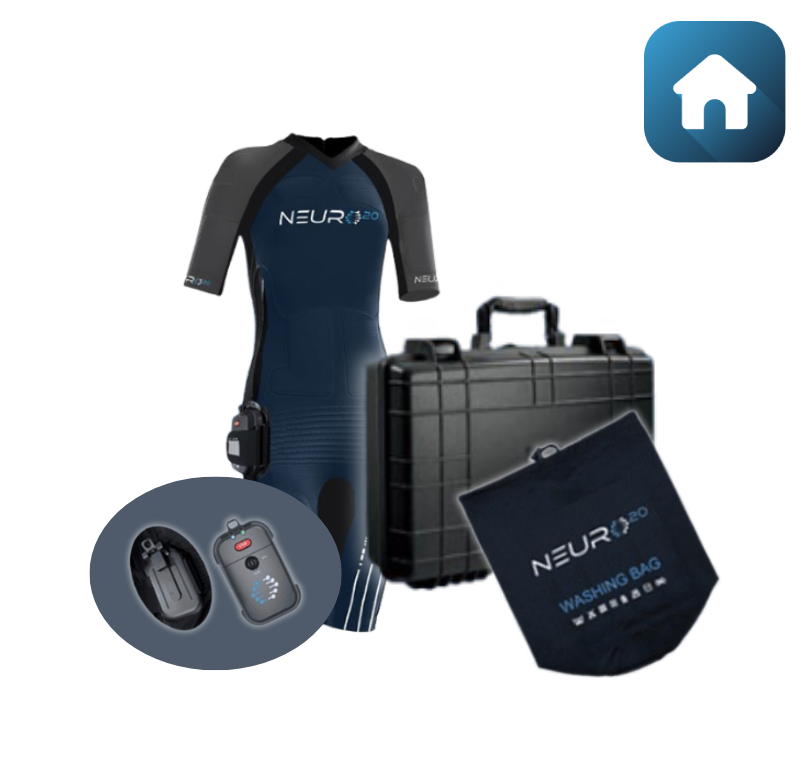
The Neuro20 Personal Home Solo Fit System is an FDA-cleared, wireless suit with 20 electrode zones targeting 42 muscles. It uses four powerful modes to tackle stroke-related issues:
- NMES (Neuromuscular Electrical Stimulation)
- FES (Functional Electrical Stimulation)
- TENS (Transcutaneous Electrical Nerve Stimulation)
- PEMS (Patterned Electrical Muscle Stimulation)
Used 2–3 times weekly for 20 minutes, it’s a convenient, effective, and flexible home-based solution, bringing clinical-grade therapy directly to you.
How Neuro20 Helps: Addressing MS Challenges
The Neuro20 Personal Home Solo Fit System, an FDA-cleared, wireless suit with 20 electrode zones, targets 42 muscles. Used 2–3 times weekly for 20 minutes, it tackles MS pain points:
1. Muscle Weakness
NMES boosts strength. Case Study: Emma, 52, with relapsing-remitting MS, gained 40% leg strength after 10 weeks, climbing stairs easier, per Neuro20 White Paper, neuro20.com.au.
2. Spasticity
FES relaxes tight muscles. Review: “My arm stiffness dropped, letting me reach better after 6 weeks.” – Tom, 45.
3. Chronic Pain
TENS reduces burning sensations. Case Study: Lisa, 48, cut leg pain by 55% after 8 sessions, sleeping better.
4. Fatigue
PEMS improves muscle efficiency. Review: “I’m less tired doing chores after a month.” – James, 50.
5. Reduced Mobility
FES aids walking. Case Study: Sarah, 41, with progressive MS, walked 50% further after 12 weeks.
6. Loss of Independence
NMES/FES helps with dressing. Review: “I can pull on socks now, feeling more capable.” – Rachel, 55.
7. Sensory Loss
TENS boosts sensation. Case Study: Mark, 47, noted better hand feeling after 10 weeks.
8. Cognitive Issues
FES raises BDNF for brain health, per Mang et al. (2013) study link. Review: “My focus sharpened after 3 months.” – Claire, 49.
9. Bladder/Bowel Dysfunction
Indirect aid via core strength. Case Study: Ben, 53, saw better control after 12 weeks with NMES.
10. Emotional Struggles
Physical gains lift mood, per Feinstein et al. (2014) study link. Review: “I feel hopeful with stronger legs.” – Kate, 46.
Quadriplegic MS Patient Progress
Why Neuro20 Stands Apart
Backed by science, proven by results, and designed for your confidence.
Why Neuro20 Is Different from Pharmacy EMS Machines
Basic EMS devices from chemists focus on fitness or minor pain relief. The Neuro20 Personal Home Solo Fit System, however, is an FDA-cleared rehabilitation tool for neurological conditions like MS. Its Pro System, used in clinics globally, underwent strict testing for safety and efficacy. The Home System brings NMES, FES, TENS, and PEMS to you via a phone app, offering clinical-grade precision for neuroplasticity and symptom relief, unlike simpler, non-specialised drugstore options, per Neuro20 White Paper, neuro20.com.au.
The Science Behind Neuro20
MS management benefits from neuroplasticity, the brain’s ability to adapt, per Lublin et al. (2014) study link. Neuro20 supports this by:
- Muscle Activation: NMES/FES strengthens nerve-muscle links, per Doucet et al. (2012) study link.
- Pain Relief: TENS eases discomfort, improving daily life, per Sluka & Walsh (2003) study link.
Circulation: PEMS boosts blood flow, aiding repair, per Kern et al. (2020) study link.
“My MS fatigue was crippling. Neuro20 got me moving more in 10 weeks.” – David, 51, MS patient
Detailed Case Studies and User Reviews
Case Study 1:
Anna, 44, Relapsing-Remitting MS
- Background: Leg weakness, frequent stumbles.
- Therapy: 3x weekly Neuro20 sessions for 12 weeks.
- Outcomes: 50% strength gain, steadier walking, less fatigue, per Neuro20 White Paper.
Case Study 2:
Paul, 58, Primary Progressive MS
- Background: Arm spasticity, pain disrupted sleep.
- Therapy: 2x weekly sessions for 10 weeks.
- Outcomes: 45% less stiffness, 60% pain drop, better rest.
Case Study 3:
Emily, 39, Relapsing-Remitting MS
- Background: Hand numbness, weak grip.
- Therapy: 3x weekly sessions for 8 weeks.
- Outcomes: 40% grip improvement, better sensation, held a pen.
Case Study 4:
Liam, 47, Secondary Progressive MS
- Background: Fatigue, relied on a walker.
- Therapy: 2x weekly sessions for 12 weeks.
- Outcomes: 35% more stamina, reduced walker use, less spasticity.
Neuro20 vs. Weekly Physiotherapy: A Cost Comparison
Weekly Physiotherapy
Weekly physiotherapy at $100–$150 per session adds up significantly over time:
- 1 Year: 52 sessions at $125 average equates to an estimated $6,500.
- 2 Years: This rises to a substantial $13,000.
- Inconvenience: Requires regular travel and strict appointment scheduling.
- Consistency Challenges: Dependent on availability and personal commitments.
Neuro20
Neuro20 offers a streamlined, cost-effective solution for consistent therapy right at home:
-
- Cost: A one-time purchase of just $4,499.
- Flexible Payment: Or approximately ~$79.09/week with Humm.
- Risk-Free Trial: Backed by a 30-day money-back guarantee.
- Unmatched Convenience: Provides long-term savings and home convenience.
- Consistent Therapy: Enjoy therapy without the need for travel or appointments.
- Complementary Use: Can complement existing physiotherapy, potentially reducing session frequency and overall costs.
Neuro20 One-Time Investment
Secure your comprehensive home recovery system for:
$4,499
One-time payment
With a 30-day money-back guarantee!
Neuro20 offers long-term savings, unparalleled home convenience, and consistent, clinical-grade therapy without the hassle of travel or appointments. It’s a powerful complement to traditional physio, potentially reducing the frequency of in-clinic sessions.
Ready to Reclaim Your Life?
Take the first step towards a stronger, more independent future with Neuro20.
What’s Included in the $4,499 Price
- Smart Suit: Antimicrobial, machine-washable, with 20 electrode zones for comprehensive coverage.
- Control Box: Portable and Bluetooth-enabled for easy, wireless control.
- Phone App: Simple, intuitive interface for complete session control from your smartphone.
- Accessories: Includes a wash bag, batteries, and charger.
- Comprehensive Support: Enjoy a 12-month warranty, a 30-day money-back guarantee, and three free 30-minute EMS specialist sessions (video or in-person in Wollongong) to get you started confidently.
Affordable Payment Options
- Credit Card or Bank Transfer: Total: $4,499.
- Payright: Pay over 6–12 months. Learn more at https://payright.com/how-it-works/.
- ZipMoney: A great option to pay off over 12 months. Details at https://zip.co/au.
- Humm: Spread payments over 12 months. See how it works at https://www.shophumm.com/au/how-it-works/.
- AfterPay: Pay in 4 payments, every 2 weeks. Find out more at https://www.afterpay.com/en-AU/how-it-works.
- NDIS Funding: May cover part or all of $4,499, but requires a complex, lengthy approval process.
We are happy to arrange an invoice or split payments to suit your needs. Contact us to discuss options.
Scientific References
Next Steps
To explore Neuro20 or try the suit, book a consultation at https://link.hublytics.co/l/RIEMPzddAi, email info@neuro20.com.au, or text 0440 131 222. Visit neuro20.com.au for more details.